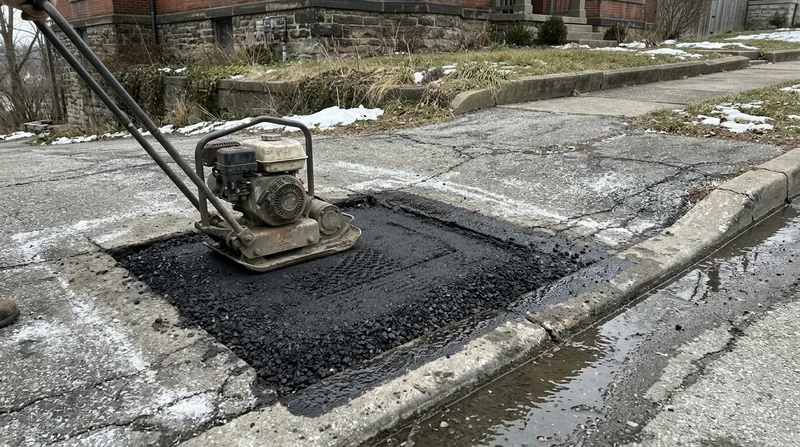




Potholes in St. Joseph arrive fast and deep. The freeze-thaw winters here, with ice storms that cycle from 20 degrees to 40 degrees and back, crack asphalt and open holes across driveways and parking lots from December through March. The loess bluffs on Museum Hill and Hall Street and Cathedral Hill shed water hard, and the river-bottom clay around the Belt Highway holds moisture that expands under frost. Pothole repair and asphalt patching in St. Joseph is not a cosmetic fix, it is damage control before one hole spreads into a failed section. We cut potholes square, tack-coat the edges, and fill them with compacted hot mix asphalt. We also run infrared patching that recycles the surface in place for seamless repairs with no waiting. When a pothole opens in March or April, getting a quick assessment stops the damage from widening through the spring thaw. Learn about our full driveway repair options to understand whether patching is the right move or whether your driveway needs resurfacing.
Why Pothole Repair Matters in St. Joseph's Freeze-Thaw Climate
St. Joseph sits on the Missouri River loess bluffs and the river bottoms, both of which amplify freeze-thaw damage. The city averages 38 inches of rain a year, and the long run of winter nights below freezing followed by days above 32 degrees opens pavement fast. Salt and plow blades chew edges from December through March, and by April, a single pothole can become a series of failures that cost thousands to repair. The 2019 Missouri River flood showed how fast high water can undercut low pavement, and the wet springs that follow leave the base soft and prone to collapse under traffic.
- Water enters cracks in fall and early winter, then freezes and expands, breaking the surface apart.
- Plow blades and salt widen the hole edges and accelerate deterioration through the winter.
- Spring melt and heavy rain drain into the base layer, softening the foundation under the hole.
- Traffic pounds the weakened edges, and the hole grows into a failed section that requires resurfacing or replacement.
Patching a pothole early stops this chain. A hole left open through a thaw cycle can double in size and depth, turning a 200-dollar repair into a 2,000-dollar resurfacing job.
Key info: In St. Joseph's Midtown and Wyatt Park neighborhoods, narrow side driveways on bungalows and foursquares built in the 1900s-1920s sit decades past their surface life. These driveways carry hard freeze-thaw cycles and often fail in patches. Patching holds when the base is sound; if alligator cracking spans more than 30 percent of the surface, the base is failing and resurfacing is the honest choice.
For more detail on what happens to pavement in this climate, see the City of St. Joseph municipal website for information on street maintenance and drainage standards that apply to private driveways and parking lots.
How We Repair Potholes and Patch Asphalt in St. Joseph
We use two proven methods depending on the hole size, the surrounding pavement condition, and whether the base is solid. Square-cut patching is the industry standard for isolated potholes and small failures. Infrared patching is faster, seamless, and leaves no cold joint for water to enter. Both methods start with a clear assessment of whether the base can hold a patch or whether the section needs resurfacing.
- We measure and document the pothole, test the base for soundness, and photograph the surrounding pavement to assess whether patching is the right call.
- For square-cut patches, we cut the hole into a clean rectangle, remove all loose material, and tack-coat the edges to bond the new asphalt.
- We place and compact hot mix asphalt in layers, using a plate compactor to achieve proper density and a smooth finish.
- For infrared patches, we heat the existing pavement with an infrared heater, scarify the surface, add new asphalt, and blend it seamlessly with the surrounding area in one pass.
- We allow the patch to cure and harden before opening it to traffic, typically 24 to 48 hours depending on temperature and traffic load.
The choice between methods depends on the job. A single pothole on a driveway that is otherwise sound calls for a square-cut patch. Multiple failures scattered across the surface, or alligator cracking near a pothole, signal that resurfacing is the better investment.
Example: A homeowner in St. Joseph's South Side near the old stockyards discovered two potholes in their single-car drive after a March thaw. The base was solid, the surrounding pavement was intact, and the holes were isolated. We cut them square, tack-coated and filled them with hot mix, and the drive held for years. Had the entire drive shown alligator cracking, we would have recommended resurfacing instead.
To understand the full range of repair options and when to move from patching to resurfacing, see our asphalt resurfacing and overlay page.
Pothole Repair Methods: Square-Cut Patching vs. Infrared Patching
| Method | Process | Best For |
|---|---|---|
| Square-Cut Patching | Cut hole into rectangle, remove debris, tack-coat edges, compact hot mix asphalt in layers, finish level with surrounding pavement. | Single or isolated potholes on otherwise sound pavement, budget-conscious repairs, driveways with solid base. |
| Infrared Patching | Heat existing pavement with infrared heater, scarify surface, add new asphalt, blend seamlessly in one pass, no cold joint. | Multiple potholes, larger damaged areas, seamless appearance critical, faster turnaround, minimal surface disruption. |
| Full-Depth Replacement | Remove section of pavement down to base, inspect and repair base if needed, compact new asphalt to full depth, compact and finish. | Pothole damage extends to base, base is compromised by water or erosion, multiple failures in same area, long-term durability required. |
| Asphalt Resurfacing | Mill or remove top layer of failed pavement, prepare base, compact new asphalt overlay to 1.5 to 2 inches, finish and cure. | 30 to 40 percent or more of surface failed, alligator cracking widespread, base is sound but surface is shot, cost-effective alternative to full replacement. |
The method we choose depends on what we find on the site. If the base is soft or the pothole has spread into surrounding pavement, patching alone will not hold. We explain the options clearly and recommend the repair that will last.
Pothole Repair and Asphalt Patching Cost in St. Joseph: What to Expect
A single pothole repair in St. Joseph starts at around 450 dollars for a square-cut patch on a residential driveway. The cost moves up with the size of the hole, the depth of the damage, the condition of the surrounding pavement, and whether the base needs reinforcement. A parking lot with multiple scattered potholes will cost more per hole because we can amortize equipment setup and labor across more work. An infrared patch, which is seamless and faster, typically runs 50 to 100 dollars more than a square-cut patch but avoids a visible cold joint and the risk of water entering the seam.
Factors that affect the final cost include the following:
- Pothole depth and the amount of material needed to fill it properly and compact it to the right density.
- Base condition: if the base is soft or eroded, we may need to add stone and compact it before patching.
- Surrounding pavement: if the hole has cracked or broken the edges, we may need to cut a larger area to achieve a clean repair.
- Accessibility and traffic control: a pothole on a busy parking lot or a tight residential drive may require more setup time and safety measures.
- Season and weather: hot mix asphalt is placed April through November in St. Joseph; winter repairs require special equipment and materials, which cost more.
Getting 2 to 3 estimates is smart. A written estimate should include the size of the area being patched, the thickness of the new asphalt, the tonnage of material, and the method being used. If an estimate does not include these details, ask for them. See our full pricing overview for pothole repair and other asphalt services in St. Joseph and the surrounding area.
What to Look for When Hiring an Asphalt Paving Contractor Near Me in St. Joseph
The most important step is to verify that any contractor you hire is fully insured and carries the credentials your city requires. St. Joseph sets licensing and permitting requirements through the City of St. Joseph Building Division. Before you hire, call the building department and ask what documentation a paving contractor must carry. Get the contractor's insurance certificate and keep it on file. Ask for references from recent pothole repairs or asphalt patching jobs in St. Joseph or nearby towns like Savannah, Platte City, or Cameron, and call at least two of them.
Red flags in the paving trade are well-known. Unsolicited door-to-door offers, no written contract, a large cash deposit upfront, out-of-state license plates, a price that is too good to be true, and an estimate with no thickness or tonnage details are all warning signs. An honest contractor gives you a written estimate with the scope clearly spelled out, the materials specified, and the method explained. We provide written estimates and tonnage specs for every job, and we answer questions about why we are recommending a particular repair method.
Ask whether the contractor is local. A shop with a local address, local phone number, and local plates is verifiably invested in the community and its reputation. That is the strongest trust signal in this trade. Contact us for a free estimate and we will walk you through the repair options for your pothole or damaged section.
Pothole Repair & Asphalt Patching in St. Joseph: Pricing Guide
| Service | Price | Details |
|---|---|---|
| Single Pothole Repair (Square-Cut Patch) | Starting at $450 | One isolated pothole, clean cut and fill, includes material and compaction labor on residential driveway |
| Infrared Patching (Seamless Repair) | Starting at $550 | Seamless blend with existing surface, no cold joint, faster cure, best for visible or high-traffic areas |
| Multiple Potholes or Larger Damaged Area | On estimate | Size, base condition, surrounding pavement, and whether full-depth replacement or resurfacing is needed determine final cost |
| Parking Lot Pothole Repair (Per Hole) | Starting at $400 | Commercial parking lots, amortized setup across multiple holes, may include traffic control and safety measures |
| Emergency or Off-Season Repair | On estimate | Winter patching requires special materials and equipment, adds 20 to 40 percent to standard cost |
| Free Estimate and Site Assessment | No charge | Response within 24 hours at (816) 596-9077, no obligation to book, written estimate with tonnage and method included |
Indicative pricing, the exact cost depends on square footage, finish, and site access. Free personalized estimate within 24h at (816) 596-9077.


