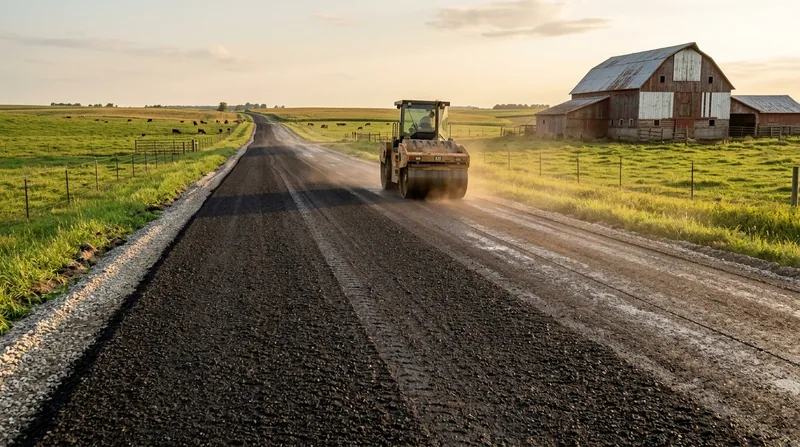




Recycled asphalt and millings driveways in St. Joseph offer a practical, budget-conscious surface that hardens and binds tighter with each hot Missouri summer. The loess bluffs and rolling farmland around St. Joseph, Savannah, and Platte City carry long gravel lanes and equipment pads that take real punishment from freeze-thaw cycles and seasonal flooding, yet hot mix asphalt runs only April through November here. Recycled millings bridge that gap: they compact solid, shed water properly when graded right, and cost a fraction of new asphalt while lasting years longer than loose gravel. We grade, spread, and roll millings to the slope and density your drive needs, and we tell you plainly when the difference between millings and hot mix is worth the money.
Why Recycled Asphalt Millings Matter on St. Joseph Driveways and Farm Lanes
The ground beneath St. Joseph climbs steep loess bluffs on the north and west, where deep wind-blown silt erodes fast when water runs off pavement. The South Side near the old stockyards and packing plants runs compact worker houses with single-car drives and gravel pads that have aged past their useful life. East of the Belt Highway, 1960s and 2000s ranch subdivisions carry wide driveways that are all failing together after fifteen to twenty years of Missouri winters. Beyond town, Buchanan and Andrew and DeKalb counties hold long farm lanes and cattle-pad access roads where gravel washes away in spring rains and the county road budget does not reach. Recycled millings solve this in three ways: they compact and bind tighter every season, they shed water better than loose stone, and they cost half what new asphalt does while holding twice as long as gravel.
- Recycled millings bind progressively tighter as summer heat and traffic compact them, creating a surface that improves with age rather than deteriorating.
- We grade the base and slope the surface to shed water away from the drive and toward the street or field, preventing standing water and freeze-thaw damage.
- Millings cost roughly one-third of new asphalt for the same square footage, making them ideal for long farm lanes, equipment pads, and rural access roads.
- A millings drive lasts eight to twelve years with proper grading and maintenance, compared to three to five years for loose gravel in the same conditions.
Recycled millings are the smart choice when a gravel pad costs too much to upgrade and new asphalt is not yet justified.
Local example: A two-hundred-foot farm lane near Cameron carrying cattle and equipment traffic holds loose gravel for five years before washboard and rutting force re-grading. Recycled millings on that same lane, properly compacted and sloped, stay smooth and drainable for ten to twelve years. A half-mile private road in Platte City with three to four vehicles per day and winter plowing holds millings for a decade without the edge crumbling or the center sagging that new asphalt would show after the same freeze-thaw cycles.
For detailed guidance on how St. Joseph's terrain and seasonal weather affect driveway choice, see our page on gravel driveway installation and grading, which covers base preparation and drainage on the same loess and clay soils.
How We Install Recycled Asphalt and Millings Driveways in St. Joseph
Recycled asphalt millings installation begins with site grading and base preparation. We measure the drive, assess the drainage slope, and remove any large debris or standing water. If the base is soft or unstable, we add crushed stone or compact the existing soil to create a stable foundation. We then spread the recycled millings to a depth of two to three inches and compact them in lifts using a vibratory roller, which locks the particles together and creates a tight, water-shedding surface. The entire job is graded to slope away from structures and toward the street or field, so water runs off instead of pooling.
- We measure the drive length, width, and any low spots or drainage issues before quoting tonnage and labor.
- We remove existing loose gravel or debris and assess the subgrade for stability and bearing capacity.
- We add a base layer of crushed stone if the soil is clay-heavy or has failed to drain, as is common on the river bottoms near Savannah and the Belt Highway.
- We spread recycled millings in two-inch lifts and compact each layer with a vibratory roller to lock the particles and create a solid, water-shedding surface.
- We slope the finished surface away from your home or building to direct water toward the street or drainage area.
- We provide a written estimate with tonnage, depth, and labor so you know exactly what the job includes.
A typical residential driveway millings job takes one to two days depending on length and base condition; a long farm lane or equipment pad may take three to five days with multiple compaction passes.
Example: A 150-foot residential drive in Hyde Park with a clay subgrade and standing water issues receives three inches of recycled millings over a two-inch base of crusher run, then two passes with the vibratory roller. The surface sheds water, compacts tight, and the homeowner can drive on it immediately. A 400-foot private road in Gower serving three houses receives four inches of millings over four inches of crushed stone, compacted in two lifts, with proper slope and a swale on the downhill side to catch runoff.
For more on base preparation and the difference between millings and full asphalt replacement, see our asphalt driveway paving and installation page.
| Approach | Description | Best for |
|---|---|---|
| Recycled Millings Only | Two to three inches of compacted recycled asphalt millings on stable or prepared subgrade, no base layer. | Short driveways, equipment pads, and areas with good existing drainage and firm soil. |
| Millings with Crusher Run Base | Four inches of crushed stone base, then three inches of recycled millings, both compacted in lifts and sloped for drainage. | Long residential drives, farm lanes, and areas with clay soil or seasonal water issues common in St. Joseph and the river bottoms. |
| Deep Grading with Millings | Full site grading to establish slope and drainage, crushed stone base, recycled millings, and swale or drainage feature on downhill side. | Private roads, HOA common drives, equipment access lanes, and sites where water has pooled or caused erosion in previous years. |
| Millings to Hot Mix Upgrade Path | Install recycled millings now with proper base and slope, documented for future upgrade to hot mix asphalt when budget allows or traffic increases. | New rural properties, farm expansions, and budget-conscious homeowners who may pave in five to ten years when the drive has proven itself and funding is available. |
Recycled Asphalt and Millings Driveways Cost in St. Joseph: What to Expect
Recycled asphalt millings driveways cost significantly less than new hot mix asphalt because the material is reclaimed from milling operations and paving demolition, not manufactured from raw aggregate and fresh binder. A typical millings drive runs from $3 to $5 per square foot installed, depending on base condition, depth, and grading complexity. A 1,500-square-foot residential driveway with stable subgrade and minimal grading costs between $4,500 and $7,500. A 3,000-square-foot farm lane or equipment pad with poor drainage and deep grading runs $9,000 to $15,000. Long private roads serving multiple properties or carrying heavy equipment traffic may run higher because of the tonnage and compaction passes required.
The main factors that move cost up or down are subgrade condition (clay soil or standing water requires a thicker base), drive length and width (longer drives cost less per square foot because grading and setup are fixed), and whether we need to address drainage swales or erosion control. A free on-site estimate accounts for all of these and gives you a tonnage figure and labor breakdown so you understand what the price covers. Get two or three estimates from local contractors before deciding; millings pricing varies based on material sourcing and crew efficiency, and a written estimate with tonnage and depth is the only honest way to compare.
See our full pricing page for typical ranges on all our services and to understand what drives costs up or down in your specific situation.
Recycled Asphalt and Millings Driveways Near Me: What St. Joseph Homeowners Should Know When Hiring
Hiring the right contractor for recycled asphalt millings work means checking three things: verifiable local presence, a written estimate with tonnage and depth, and honest talk about when millings make sense versus when new asphalt is the better choice. A local contractor with a St. Joseph address and local plates has a reputation to protect and will not disappear after the job. An estimate on paper that names tonnage, depth, and labor cost lets you compare apples to apples with other bids. A contractor who tells you millings will last eight to twelve years under normal conditions, not a lifetime, and who explains why your specific drive needs a base layer or better grading, is giving you honest advice.
- Ask the contractor to show you the tonnage and depth on the written estimate so you can verify the material quantity and compare it fairly with other bids.
- Check whether the contractor is fully insured and ask to see a certificate of insurance; licensing and permitting requirements vary by city, so verify with your local building department what applies to your property.
- Get references from the contractor and call two or three past customers to ask whether the drive has held up and whether the contractor showed up on time and cleaned up after the job.
- If your property is in an HOA or a historic district, verify that recycled millings meet the architectural standards or deed restrictions before hiring; some communities restrict driveway materials to asphalt or concrete only.
- Ask whether the contractor will handle any required permits or site inspections; permitting rules vary from St. Joseph to Savannah to Platte City, and it is your responsibility to verify with your city or village before work begins.
Honest paving contractors earn trust by being local, transparent about what the job costs and why, and straightforward about when repair or resurfacing beats replacement. Call us at (816) 596-9077 for a free estimate and we will walk you through the options for your specific driveway.
Recycled Asphalt & Millings Driveways in St. Joseph: Pricing Guide
| Service | Price | Details |
|---|---|---|
| Residential driveway, stable subgrade | From $3/sq ft | Recycled millings spread and compacted two to three inches, minimal grading, suitable for short drives with good existing drainage |
| Residential or farm driveway with base preparation | From $4/sq ft | Four-inch crushed stone base plus three-inch millings layer, both compacted, slope and drainage grading included, typical for clay soil or long drives |
| Long farm lane or private road with full grading | From $5/sq ft | Deep site grading, swale or drainage feature, crushed stone base, recycled millings, multiple compaction passes, serves multiple properties or equipment traffic |
| Complex or large-scale installation | On estimate | Extensive erosion control, poor subgrade conditions, or drives longer than one-half mile require on-site measurement and soil assessment before pricing |
| Travel and setup | Included | No separate mileage fee or travel charge for jobs in St. Joseph, Savannah, Platte City, and surrounding service area |
| Estimate | Free | On-site measurement, tonnage calculation, and written quote within 24 hours, no obligation to book, call (816) 596-9077 |
Indicative pricing, the exact cost depends on square footage, finish, and site access. Free personalized estimate within 24h at (816) 596-9077.


